Feeding outdoor cats involves providing reliable nutrition while preventing access by opportunistic wildlife that can create safety, sanitation, and behavioral problems.
In outdoor environments, food left unattended becomes a powerful attractant for intelligent nocturnal animals that quickly learn feeding patterns and locations.
Visit our articles page for expert advice, product recommendations, and adventure ideas.
This article explains how to feed outdoor cats and not raccoons by focusing on timing, placement, equipment choices, real-world scenarios, and common mistakes that sabotage otherwise good intentions.

How to Feed Outdoor Cats and Not Raccoons?
To feed outdoor cats and not raccoons, food must be offered only during daylight hours, placed in controlled locations, served in limited portions, and removed immediately after cats finish eating. These steps work together to eliminate nighttime access and remove the reward that keeps raccoons returning.
When applied consistently, this approach allows cats to eat safely while raccoons lose interest and move on.
Feed Outdoor Cats Only During Daylight Hours
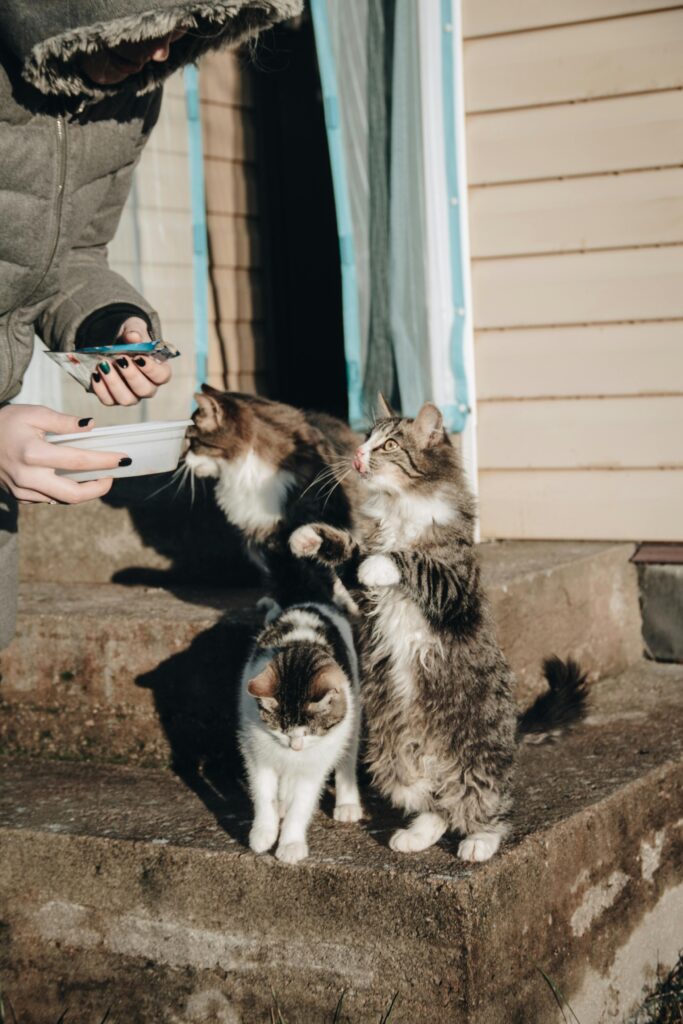
Timing is the most effective and humane way to prevent raccoon interference. Outdoor cats are generally active during daylight and twilight hours, while raccoons are primarily nocturnal.
Daytime feeding works because it removes overlap between cats and raccoons. A consistent schedule also trains cats to eat promptly instead of grazing.
Key daytime feeding practices include:
- Feeding early morning or late afternoon
- Offering food for a limited window
- Removing all food within 20–30 minutes
- Never leaving food out overnight
When timing is controlled, raccoon visits often stop within days.
Control Portions and Remove Food Immediately
Leaving food out is the most common reason raccoons keep returning. Even small leftovers provide enough scent and reward to reinforce the behavior.
Proper food control means watching cats eat when possible and removing bowls as soon as they finish. Surfaces should be wiped down to eliminate odors, and all food should be stored indoors in sealed containers. This routine breaks the cycle that teaches raccoons a feeding location is reliable.
Use Raccoon-Resistant Feeding Equipment
Equipment alone will not solve the problem, but it becomes highly effective when paired with proper timing and portion control.
Raccoon-resistant feeding options include:
- Weight-activated feeders that close under heavier animals
- Enclosed feeding boxes sized for cats
- Automatic feeders programmed for daytime use
- Gravity feeders placed inside secured enclosures
These tools reduce access, but they must never be used for overnight feeding.
Know if outdoor bleach the same as regular bleach?
Elevate Feeding Stations Strategically
Elevation can discourage raccoons when designed correctly, even though raccoons are capable climbers. The goal is not height alone, but controlled access.
Effective elevated setups typically involve smooth metal poles, narrow platforms sized only for cats, and baffles that prevent climbing. Feeding stations should be placed away from nearby trees, fences, or structures that allow jumping access.
Choose Feeding Locations With Care
Placement determines whether a feeding setup works long term. Feeding areas should feel familiar and safe for cats while remaining inconvenient for wildlife.
Good locations are visible, dry, close to cat shelters, and away from trash, compost, and dense cover. Poor placement teaches raccoons exactly where to return, which makes the problem harder to reverse.
Compare Common Feeding Methods
Different feeding approaches vary widely in effectiveness. The table below shows how common methods compare in real-world use.
| Feeding Method | Raccoon Risk | Cat Safety | Long-Term Success |
|---|---|---|---|
| Ground-Level Open Bowl | Very High | Moderate | Low |
| Daytime Manual Feeding | Low | High | High |
| Weight-Activated Feeder | Low | High | High |
| Elevated Feeding Shelf | Moderate | High | Moderate |
| Enclosed Feeding Station | Low | Moderate | High |
Combining daytime feeding with controlled equipment produces the most reliable results.
Why Raccoons are Drawn to Outdoor Cat Food?
Raccoons are highly adaptable foragers with excellent memory and problem-solving skills, which makes outdoor feeding areas especially attractive to them. Once a raccoon finds a dependable food source, it will return repeatedly and may even teach others where to find it.
They are drawn to outdoor cat food because it is calorie-dense, easy to access, and often left out overnight when raccoons are most active. Understanding this behavior is essential, because stopping raccoons is less about deterrents and more about removing opportunity.
Common Mistakes That Attract Raccoons
Most raccoon problems persist because of simple but critical mistakes. These include feeding at night, leaving food unattended, using ground-level bowls, and failing to clean feeding areas.
Correcting these errors usually reduces raccoon activity quickly without needing repellents or traps.
Real-World Feeding Scenarios
In suburban yards, daytime feeding combined with elevated or enclosed stations works well when food is removed promptly. In rural or wooded areas, stricter control is needed, often using weight-activated feeders and greater elevation. In apartment or balcony settings, timed feeders and close monitoring are usually sufficient.
Adapting methods to the environment ensures consistency and long-term success.
FAQs
The following frequently asked questions address common concerns and edge cases people encounter when trying to feed outdoor cats without attracting raccoons.
Can raccoons open cat feeders?
Yes, raccoons can open many standard feeders. Weight-activated or fully enclosed feeders designed to exclude heavier animals are far more effective.
Is it safe to feed outdoor cats only once per day?
Yes, many outdoor cats adapt well to once-daily feeding if portions are adequate, though twice-daily daytime feeding often works best.
Will raccoons stop coming back if food is removed?
In most cases, raccoons stop returning within a few days once food access and food odors are completely eliminated.
Do raccoon repellents work near feeding areas?
Repellents have limited effectiveness near food sources and should not be relied on as a primary solution.
Can feral cats be fed without attracting wildlife?
Yes, strict daytime schedules, controlled portions, elevated or enclosed feeders, and immediate food removal allow feral cats to be fed safely.
These answers reinforce that consistency, not deterrents, is the key to long-term success.
Conclusion
Feeding outdoor cats without attracting raccoons requires disciplined timing, controlled portions, smart placement, and immediate food removal. When these practices are followed consistently, cats eat safely and raccoons lose interest altogether.